
Last week, I shared some exciting news: Team OWL is racing in our first-ever ZRL series. I’m thrilled to report that not only are we learning a ton—we’re having a blast, too!
If you’ve followed my work, you might remember my piece from last March, Women’s Racing on Zwift: An Unfinished Journey Towards Equality, where I explored the flaws in how women’s performance in Zwift racing is measured. This time, I’ll build on that discussion, reflecting on what ZRL racing has taught me firsthand.
ZRL Race 2 Context
Our first points race in ZRL, took place on the 2019 UCI Worlds Harrogate Circuit—a 13.8 km rollercoaster of a route with 245 meters of climbing, a mix of sprints, and just enough flat sections to make your legs beg for mercy. Team OWL put in an impressive effort, snagging strong FAL points on the climbs even without any FTS wins. We were clearly racing above our fitness levels, pushing hard against a tough field. One moment, though, stood out from the start line—a rider suggested we take it easy for the first 5 km, holding a steady 2 w/kg to stay together—similar to a 'neutralized start' in the pro peloton.
The 2 w/kg Warm-Up Trap
At first, that idea sounded thoughtful: a neutralized start to keep the pack intact and give everyone a chance to settle in. But, as is often the case on Zwift, the numbers tell a different story. The rider making the suggestion likely meant well—but probably didn’t realize how “2 w/kg” means very different things depending on one key variable: weight.
Here’s how it plays out. The rider who made the call weighs 69.3 kg, so at 2 w/kg, she’s producing 138.6 watts (69.3 kg × 2 w/kg = 138.6 w). For a lighter rider like me—around 50 kg—to match that same absolute power, I’d have to ride at 2.77 w/kg (138.6 w ÷ 50 kg = 2.77 w/kg).
That so-called “easy” start? It’s basically my FTP. It might sound like a tiny difference, but trust me—it hits hard when you know riders who weigh more are able to "take it easy."
Watts vs. w/kg: What Most Don’t Understand
Here’s the thing most riders miss: when it comes to getting from point A to point B, raw watts—your absolute power output—are what really determine speed. The higher your watts, the faster you move, plain and simple.
On the other hand, watts per kilogram (w/kg) tells a different story. It’s less about speed and more about fitness—a measure of how much power you can produce relative to your body weight. That metric is great for comparing athletes or tracking progress, but it doesn’t tell the full story of race dynamics, especially on varied terrain like the Harrogate Circuit.
Still Skeptical? The Data Doesn’t Lie
Time to geek out! For this next part, we’ll compare data from two riders: the woman who suggested the “easy” start and—of course—me.
| zFTP | Weight | w/kg | CAT | Age | |
| Her Data | 165w | 69.3kg | 2.38w/kg | D | Vet 40-49 |
| My Data | 124w | 50kg | 2.48w/kg | D | 66 |
We’re both CAT D riders. Sure, her zFTP watts tower over mine—but I hold a slight edge in fitness (w/kg). And age? Just a number!
One of my favorite tools as Team OWL’s DS is the brilliant analysis platform BestBikeSplit. It’s a data lover’s dream when it comes to Zwift analysis—and thankfully, it’s as user-friendly as it is powerful. If you’d like, feel free to follow along.
Head over to the 2019 UCI Worlds Harrogate Circuit on Best Bike Split »
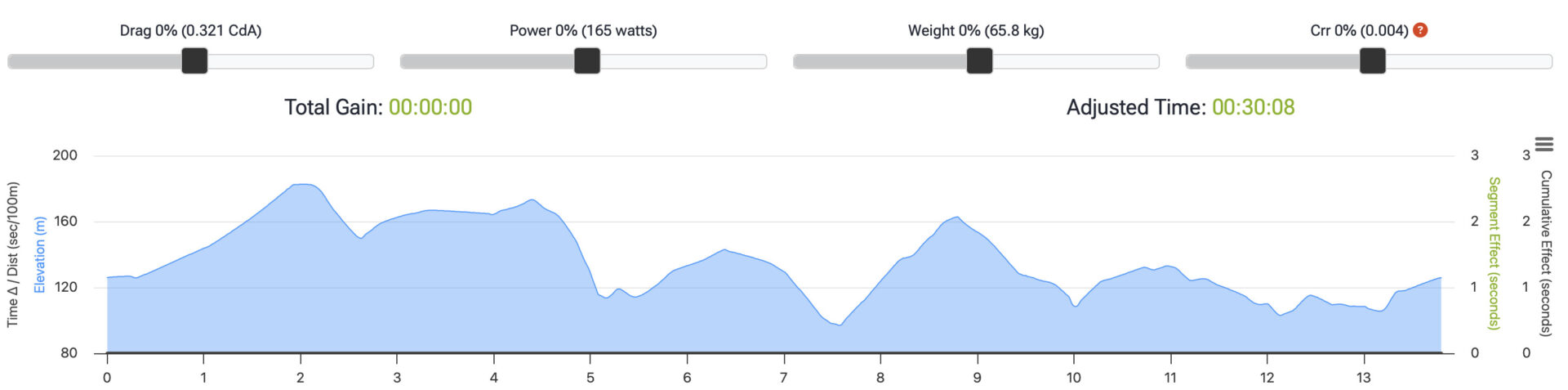
Start by hovering over the first 5 km segment of the course at the bottom of the graph. Click, drag to the left, and release to zoom in on the stretch our rider proposed neutralizing.
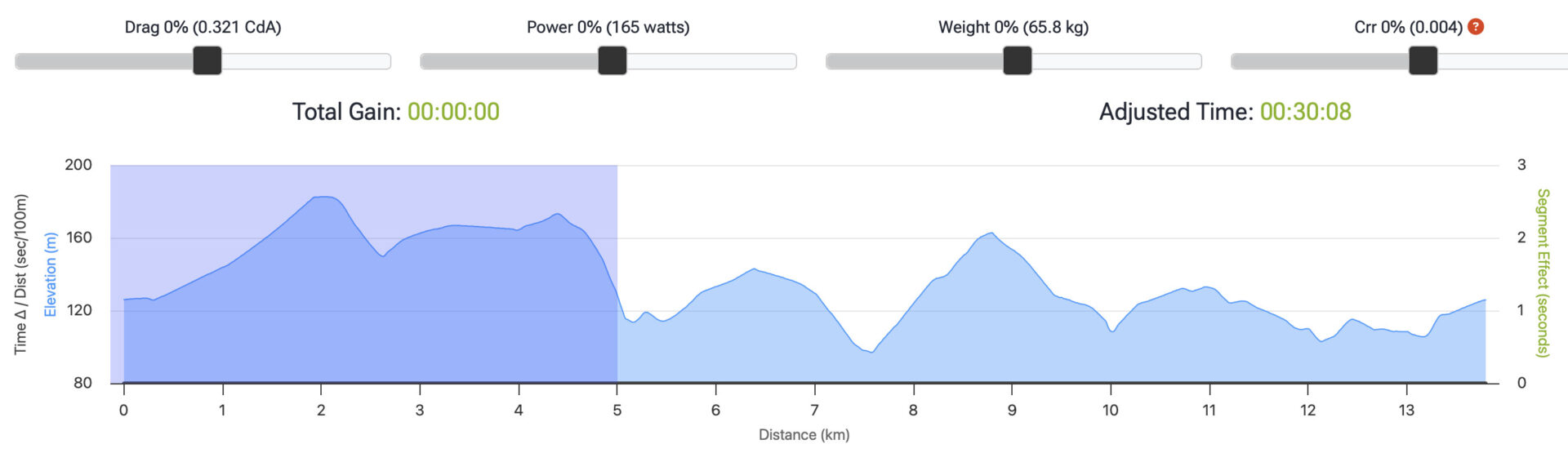
Next, set the weight bar to 69.3 kg—her weight:
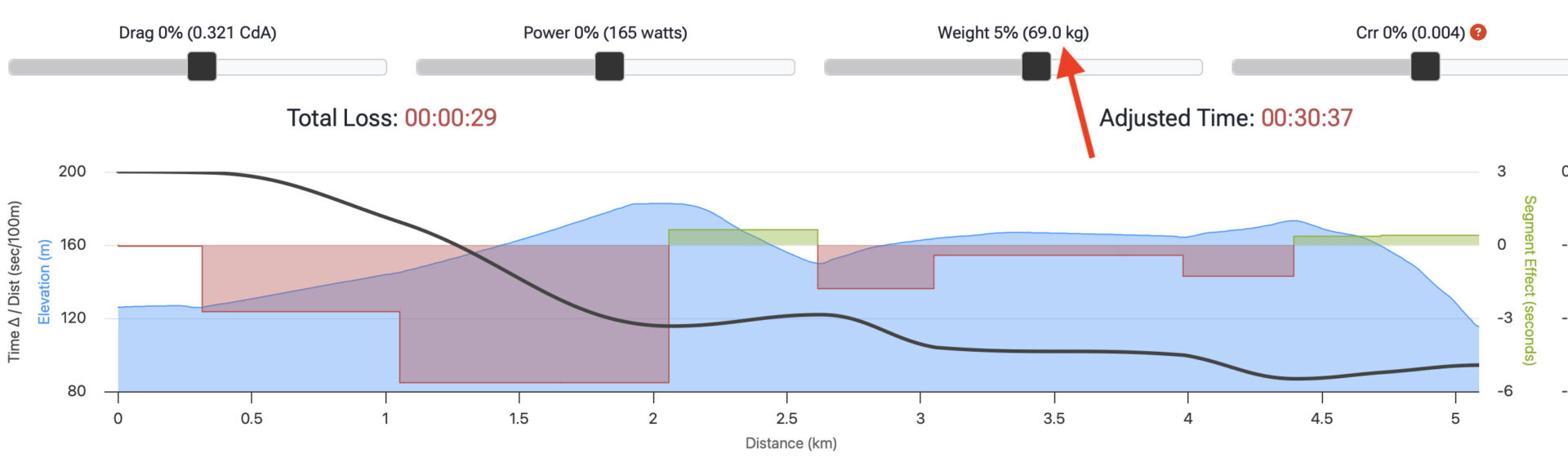
—and adjust power until her w/kg reads exactly 2.0 on the right panel, matching the suggested pace.
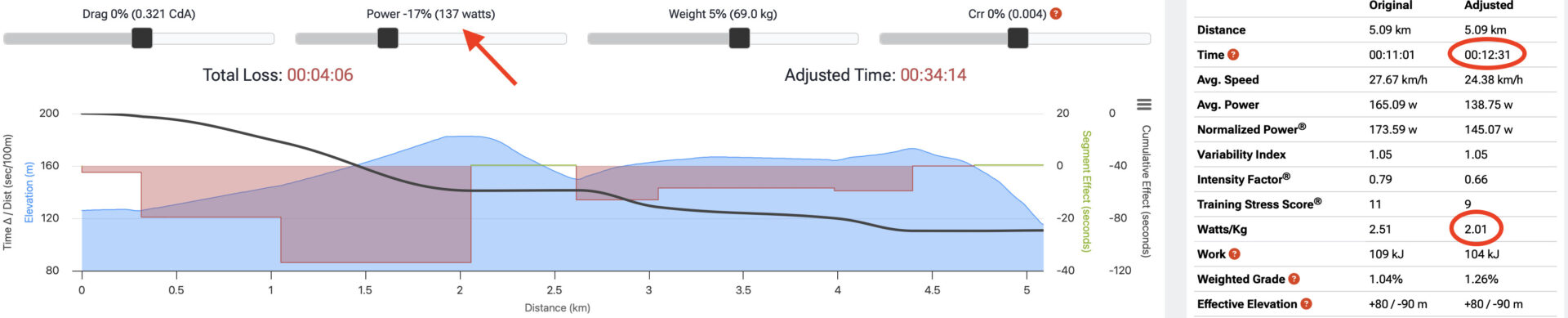
Here’s what the data shows: in the “Adjusted” column, her w/kg is 2.0, and her time over 5 km comes out to roughly 00:12:32. She’s producing about 137 watts, comfortably below her zFTP of 165w, riding in Zone 3 Tempo (125–149w)—a steady, manageable effort.
Now, without changing any other setting, drop the weight to 50 kg—my weight. Instantly, the picture shifts. My relative effort jumps, even though the pace is the same.
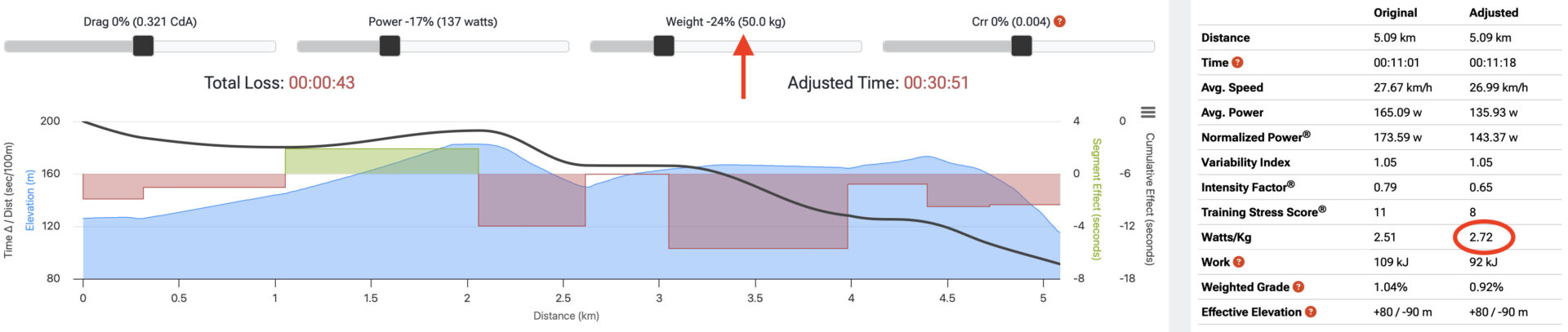
Look at the Adjusted w/kg: while she rides at 2.0 w/kg, I’m working at a noticeably higher 2.72 w/kg. But that’s not the full story—physics has a few more cards to play. My projected 5 km time actually comes in faster, at 00:11:19, which clearly isn’t realistic if we’re staying together. So, let’s correct for that.
Slide the power bar until my time matches hers—00:12:32. Now, my w/kg drops to 2.28, still higher than her 2.0 but less extreme than the initial 2.72 estimate. At that effort, I’m riding in Zone 4 Threshold (113–130w)—and as every cyclist knows, Yellow feels a lot harder than Green.
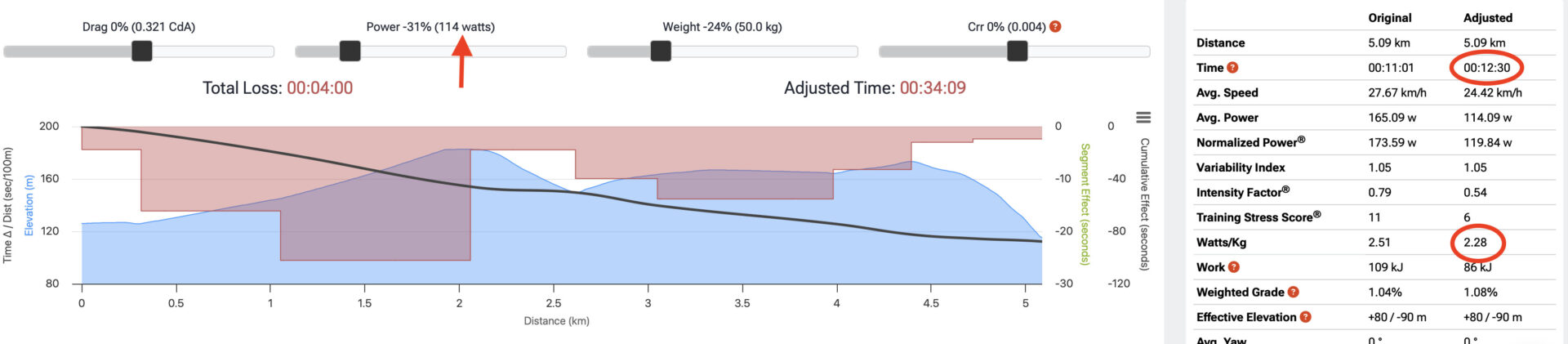
Why the drop from 2.72 to 2.28? Simple: the Harrogate course isn’t flat—it packs in a fair amount of elevation gain, which changes the physics.
Try this same test on Zwift’s flattest course, Tempus Fugit, and you’ll see an entirely different result. There, her 2.0 w/kg pace equals 139w, still below her zFTP (Green Zone), while I’d need to hold 2.64 w/kg at 132w, landing squarely in my VO2 Max zone (Orange)—well above my zFTP.
This is where the myths start to crumble.
Zwift Myth Buster
“Lighter Riders Always Climb Faster”
It’s a common belief in the Zwift world that lighter riders always have the upper hand on climbs—but the truth is more nuanced.
When two riders have equal fitness (the same w/kg), raw watts still rule. That’s because physics dictates that a heavier rider can naturally produce more total power simply due to greater body mass and muscle force potential.
So even if their w/kg matches a lighter rider’s, their higher absolute wattage often keeps them close—or even ahead—especially on rolling terrain or long climbs where sustained power matters most.
Fitness might be equal, but in the end, nature favors the watts.
FUN FACT: Using BestBikeSplit to analyze the same two riders climbing Alpe du Zwift at 2 w/kg: she finishes in 01:40:40, while I trail by 3 minutes at 01:43:58—despite being the lighter rider!
Why w/kg Standards Go Unchallenged
Here’s the honest truth: the majority of riders on Zwift are men. And because of that, Zwift is, in many ways, a man’s world. Most male riders tend to fall around the same average body weight—about 75 kg, which also happens to match the benchmark used for Zwift’s robopacers and many of its performance assumptions. That means the system, whether intentionally or not, is built around the physiology of the average male rider.
For these riders, racing and pacing by w/kg makes sense—it works well enough because their body size and weight align with the model. But for women, who typically have smaller frames and weigh less—even when fitness is equal—the experience can be dramatically different. The same goes for lighter men. Those differences in raw power versus relative power create a distinct disadvantage that most of the riders on Zwift aren't even aware of.
Even trusted community resources like ZwiftInsider list predicted route finish times based purely on w/kg. Now that you understand how physics actually works, you can see why those numbers don’t tell the full story. Until more of the minority—women and smaller men—become aware of this imbalance and start to speak up, the standard will remain unchallenged.
Rethinking w/kg: A Call for Fairer Racing
This isn't about strength or fitness; it's pure, undeniable physics! It’s why sometimes, after a hard race, you feel like you gave absolutely everything, but the results just don't seem to reflect your monumental effort. Frustrated? You're not alone in feeling it!
Our strength isn't always measured in watts per kilo; sometimes, it's in the wisdom to understand the game and demand a fair one!
Meaningful change starts with riders—and platforms—willing to rethink the defaults. Zwift and leagues like ZRL could begin by acknowledging that a one-size-fits-men approach to pacing, categories, and route expectations leaves many women and smaller riders working disproportionately harder for the same “numbers.”
There are some clear first steps.
- Revisit assumptions baked into tools like robopacers, route time estimates, and event pacing so they don’t quietly center a 75 kg “average” rider as the norm.
- Offer education and in-game guidance that explains how watts and w/kg affect different body sizes, so teams stop casually suggesting “easy” paces that are anything but for lighter riders.
Most importantly, platforms and organizers need to actively invite feedback from the riders most impacted: women and smaller men who consistently find themselves redlining while others cruise. Until their experiences are heard, believed, and reflected in race formats and tools, the status quo will continue to feel “fair” to the majority—and deeply flawed to everyone else.
Wrapping Up
Not to overload you—your brain has processed a lot of food for thought today! Next week, I’ll dive deeper into ZRL racing, unpacking why WTRL’s current CAT system—which leans so heavily on w/kg—doesn’t just create an uneven playing field. It actively disadvantages lighter women. Specifically, I’ll show how the numbers prove the Development League categories simply don’t add up. Stay tuned!
If you’re inspired to take a deeper dive into race planning and pacing like the analysis I’ve talked about in "Why w/kg Falls Short in Women’s Racing", consider trying out Best Bike Split’s premium tools to plan and optimize your next event. OWL.BiKe fans Save 25% off any of Best Bike Split's premium subscriptions—a great way to unlock advanced features for smarter training and race strategy. Subscribe to our newsletter, or add a comment below to receive your promo code.